A DPRK RAT's changelog, read off the blockchain
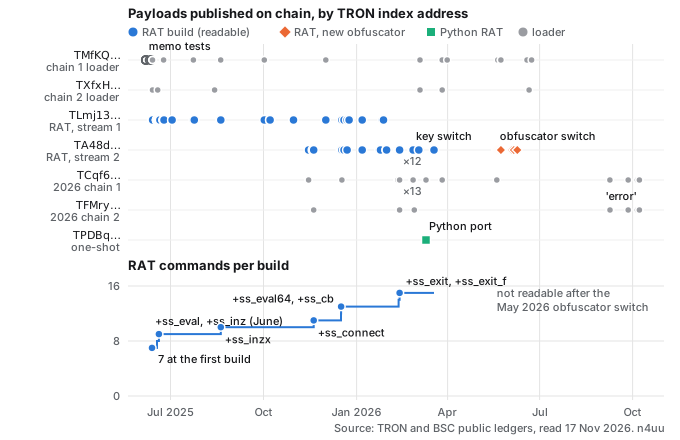
Seven TRON addresses pointed PolinRider loaders to 190 BSC transactions between June 2025 and October 2026, all sent by one wallet. 187 decrypt with the published keys. 95 are readable builds of the DEV#POPPER RAT, which grows from 7 commands to 15 over eight months before switching obfuscator. The archive also holds a Python port of the RAT published once in March 2026, three server addresses I could not find in public reporting, and the operator’s tests, ending with a payload that is just the string 'error'.
Contents
Summary
The loaders that PolinRider plants in GitHub repositories don’t carry their next stage. They read a TRON address’s latest transaction, take a BNB Smart Chain (BSC) transaction hash out of its memo, and decrypt that transaction’s input. The operator ships a new build by sending a new transaction, and nothing is ever deleted. So the chain holds every build that was ever served, in order, with timestamps.
I walked the full history of the seven TRON index addresses I could tie to
the campaign. They hold 200 transactions from 6 June 2025 to 7 October
2026. 190 of them point to BSC transactions, all sent by the same wallet,
0x9bc1355344b54dedf3e44296916ed15653844509, to the burn address. 187
decrypt with keys that are already public, into 176 distinct scripts.
95 of those are builds of the DEV#POPPER RAT that eSentire described in
March (89 distinct files), and 22 more are later builds in a different
obfuscator. Lining them up gives the RAT a changelog:
This infrastructure is not new. Ransom-ISAC’s XCTDH series and Crystal Intelligence traced the BSC wallet, its funding and the RAT’s C2 addresses through November 2025, and eSentire, SafeDep, Socket, Greenflagged and Trend Micro documented individual builds. What I could not find in public reporting is:
- the build-by-build changelog: when each command and persistence marker first shipped, and the obfuscator switch on 19 May 2026;
- a Python port of the RAT published once, on 10 March 2026, from a TRON address used for nothing else;
- three server addresses:
154.91.0[.]196,154.91.0[.]15and89.19.222[.]25. None was on ThreatFox when I checked on 17 November; - a second funding wallet that created three of the index addresses within two minutes;
- the operator’s test runs, which are also on chain.
How it was analysed
Nothing was run, and nothing talked to the operator’s servers. Every
request went to public blockchain APIs: TronGrid for TRON and a public BSC
RPC node. The decoding is the one Ransom-ISAC, SafeDep and StepSecurity
published. Take the TRON memo, hex-decode it and reverse it to get a BSC
transaction hash. Take that transaction’s input, hex-decode it, split it
on ?.? and XOR the middle part with the loader’s key. Four keys from
earlier reports cover all but three transactions.
The decrypted scripts went through crumble, which resolves javascript-obfuscator’s string array statically and can emulate a script against Node.js stubs that only record what it calls. I used the emulation only on the small loaders, to see which address or server each one reads next.
One check that the pipeline is right: BSC transaction
0x804b000af7d7e4337ba5db28bb367da64a08391de09ffb07847ac897c5f82954,
published on 27 January 2026, decrypts to a file with SHA-256
207b5feb80c67f02023a07c7271b48c1d8b07ea5b59d76f98c1b0b357fbabfb1.
That is the hash eSentire lists as “DEV#POPPER RAT (Obfuscated)”, and
crumble’s output has the same thirteen commands as their table.
The archive
| TRON index | What it serves | Transactions | Active |
|---|---|---|---|
TMfKQEd7TJJa5xNZJZ2Lep838vrzrs7mAP | chain 1 loader; the 2025 builds read TLmj13… | 27 | Jun 2025 – Jun 2026 |
TXfxHUet9pJVU1BgVkBAbrES4YUc1nGzcG | chain 2 loader, which fetches /$/boot from a C2 | 9 | Jun 2025 – Jun 2026 |
TLmj13VL4p6NQ7jpxz8d9uYY6FUKCYatSe | RAT builds, first stream | 58 | Jun 2025 – Jan 2026 |
TA48dct6rFW8BXsiLAtjFaVFoSuryMjD3v | RAT builds, second stream | 62 | Nov 2025 – Jun 2026 |
TCqf6ZkaQD84vYsC2cuu1jRwB6JveTaRrF | 2026 loaders, chain 1 | 29 | Nov 2025 – Oct 2026 |
TFMryB9m6d4kBMRjEVyFRbqKSV1cV2NcpH | 2026 loaders, chain 2 | 14 | Nov 2025 – Oct 2026 |
TPDBqDKAYfRVvVYDNZVxY8CRfovkwDaSgW | the Python RAT, once | 1 | 10 Mar 2026 |
Every BSC payload transaction, all 190, goes from 0x9bc1…4509 to
0x000000000000000000000000000000000000dEaD. That makes this the original
EtherHiding transaction shape with one more hop in front, and it means a
single sender address saw every build. Ransom-ISAC found that wallet’s
first malicious transaction on 7 February 2025, and OpenSourceMalware
found the same wallet behind the hijacked itsa-* npm packages of May 2025.
Anyone watching that address would have seen each new RAT build as it was
published.
The Aptos fallback addresses in the loaders are real accounts. They have sent 22, 10, 63 and 65 transactions, close to the counts of the TRON addresses they back up. The public Aptos fullnode no longer serves that history, so this post covers TRON and BSC only.
The changelog
The RAT is javascript-obfuscator output with an RC4 string array, and crumble reads 95 of the builds up to 18 March 2026. Command names are the ones eSentire documented. The date is the first build that carries each change:
| First published (UTC) | Change |
|---|---|
| 12 Jun 2025 | First build, 31 KB, 7 commands: ss_info, ss_ip, ss_upf, ss_upd, ss_dir, ss_fcd, ss_stop. C2 136.0.9[.]8, 166.88.4[.]2 |
| 17 Jun 2025 | Size doubles to 62 KB. +ss_eval. First persistence marker, /*C250617A*/ |
| 19 Jun 2025 | +ss_inz, which writes the stager into other applications’ JavaScript files |
| 20 Jun 2025 | C2 23.27.202[.]27 added |
| 19 Aug 2025 | +ss_inzx, which removes it again |
| 1 Oct 2025 | Second marker, /*C250618A*/ |
| 30 Oct 2025 | C2 202.155.8[.]173 added |
| 14 Nov 2025 | Second stream starts on TA48d…, with its own key and only 198.105.127[.]210 |
| 19 Nov 2025 | +ss_connect, which switches C2 at runtime |
| 16 Dec 2025 | +ss_eval64, +ss_cb (clipboard). Third marker, /*C250619A*/, the next day |
| 30 Jan 2026 | Two builds carry a Python one-liner that runs whatever hxxp://154.91.0[.]196:443/download/2 returns |
| 11–12 Feb 2026 | +ss_exit, +ss_exit_f. From here on no C2 address appears in clear text |
| 25 Feb 2026 | Fourth marker, /*C250620A*/ |
| 18 Mar 2026 | Last build crumble can read: 75 KB, 15 commands |
| 19 May 2026 | The RAT stream switches obfuscator. 22 more builds up to 8 June |
The markers are already known: Trend Micro lists them and Ransom-ISAC’s
YARA rule keys on C250617A. What the chain adds is dates. The first one, C250617A, shipped on
17 June 2025, which reads like a build date. The next three only count up,
and they arrived months apart. Each new marker is kept alongside the older
ones, presumably so that a new build recognises files that an old one
already injected.
From November 2025 to January 2026 two RAT streams ran side by side.
TLmj13… kept serving builds with the old C2 list, and from 1 December
it added 198.105.127[.]210. TA48d… served only 198.105.127[.]210.
The build eSentire analysed was the last one on the old stream.
From 19 May the RAT stream uses a different obfuscator: no javascript-obfuscator string array, generator functions and its own string decoding. Ransom-ISAC describes a new obfuscator in their September 2026 samples; I haven’t checked whether it’s the same one. crumble doesn’t handle it yet, so after 19 May I have sizes and dates but not contents.
The operator at the keyboard
The first transactions on TMfKQ… are not payloads. On 6 June 2025 the
address received 100 TRX from the fee wallet Ransom-ISAC documented,
TQdwohPCWqqfCUaCispyV1NaUZ1HgiJPUy. It then sent three 1-sun transfers
with no memo, then one with the memo Mxy custom memo text, then the same
memo to the TRON zero address. Someone was finding out how memos work.
On 11 June it tried putting the code itself in a memo. Two transactions,
one minute apart, carry 1,024 and 8,192 bytes of a javascript-obfuscator
script encrypted with cA]2!+37v,-szeU}. Both are cut off mid-script.
The next day, 12 June, the first TRON memo holding a reversed BSC hash
appears, on TLmj13…, and that is the scheme the campaign has used since. The same key, unused in
between as far as the chain shows, fronted the second RAT stream from
November.
On 25 February 2026, at 18:05 and 18:07 UTC, the same RAT build was
published twice on TA48d…, first under cA]2!+37v,-szeU} and then
under 2[gWfGj;<:-93Z^C. Everything after that uses the second key. That
was a busy evening: 12 RAT builds and 13 loaders in under four hours, one
of them with global["_V"]="00".
Test markers left in published loaders: _V='9-test' on 1 October 2025,
_V="00" on 25 February, _V='A-00' on 23 May and global.i='00-test'
on 5 October 2026. That loader and its chain 2 twin, published in the
same minute, are the only ones that point to 89.19.222[.]25, at
:443/init and /0/body.
The TRON side ends on 7 October 2026. That afternoon the chain 2 index,
TFMry…, got three payloads of 13 or 14 bytes in 13 minutes. The last one,
decrypted with that chain’s own key, is the JavaScript literal 'error'.
A loader still resolving chain 2 now evaluates a string and stops there.
A Python port on a one-shot address
On 9 March 2026 the fee wallet TQdwoh… sent 100 TRX to a fresh address,
TPDBqDKAYfRVvVYDNZVxY8CRfovkwDaSgW. The next afternoon that address made
its only transaction, a pointer to a 10.5 KB payload that isn’t
JavaScript. It’s a Python RAT built on asyncio, with the same command
vocabulary: ss_shell, ss_eval, ss_eval64, ss_cb, ss_upf,
ss_upd, ss_stop, ss_type, ss_info and ss_exit. Its configuration
falls back to SERVER_HOST=154.91.0[.]15, SERVER_PORT=443 and an upload
server at hxxp://198.105.127[.]210, where files go to /u/f. That is the
upload path OpenSourceMalware saw in the 2025 itsa-* chain.
154.91.0[.]0/24 keeps coming back: .103 was the 2025 bootstrap server,
.196 serves the Python stage in two January 2026 RAT builds and .15 is
the Python port’s C2.
The second funder
Ransom-ISAC traced the fees for the first index addresses to TQdwoh…. The
2026 addresses were paid from somewhere else.
TGJ1YJJNkFYLZKU4ZGqJfS6dU2cvGac7pS sent 50 TRX each to TFMry…,
TCqf6… and TA48d… at 15:02, 15:03 and 15:04 UTC on 13 November 2025.
That created all three addresses in one sitting, a day before TA48d…
published its first build. The same wallet topped up TLmj13… on 30
October, three minutes before that address published two builds, and sent
TA48d… another 100 TRX on 3 March 2026. TLmj13… was also funded by
TQdwoh… in June 2025, so both fee wallets serve the same set of
addresses.
Why it matters
Blocking a C2 address does little here, because the chain decides where the loader goes next. The chain is also the best telemetry anyone has on this campaign. For defenders that means three things:
Watch the writer. BSC transactions from
0x9bc1…4509to the burn address have been the payload feed since February 2025. New ones are new builds.Hunt the pattern, not the address. A TRON memo that reverses to
0xplus 64 hex characters is how every index in this post works, and it doesn’t depend on any address:curl -s "https://api.trongrid.io/v1/accounts/<addr>/transactions?only_from=true&limit=200" | jq -r '.data[].raw_data.data // empty' | while read -r h; do echo "$h" | perl -ne 'chomp; print pack("H*", $_)' | rev; echo; done | grep -E '^0x[0-9a-f]{64}$'Date the infection. Builds changed C2 addresses over time, so the date a loader ran tells you which addresses to look for in proxy logs. The CSV has every payload hash with its publish date, and each C2 address with the date it first appears.
Indicators
| Indicator | Role | Status |
|---|---|---|
0x9bc1355344b54dedf3e44296916ed15653844509 (BSC) | writes every payload | known (Ransom-ISAC, SafeDep) |
TGJ1YJJNkFYLZKU4ZGqJfS6dU2cvGac7pS (TRON) | funded TFMry…, TCqf6…, TA48d…, TLmj13… | not found in public reporting |
TPDBqDKAYfRVvVYDNZVxY8CRfovkwDaSgW (TRON) | one-shot index, Python RAT | not found in public reporting |
0x3414a658f13b652f24301e986f9e0079ef506992472c1d5224180340d8105837 (Aptos) | fallback for TLmj13… | not found in public reporting |
hxxp://154.91.0[.]196:443/download/2 | Python stage fetched by two Jan 2026 RAT builds | not found in public reporting |
154.91.0[.]15:443 | Python RAT C2 | not found in public reporting |
89.19.222[.]25:443/init, hxxp://89.19.222[.]25/0/body | 00-test loader, Oct 2026 | not found in public reporting |
hxxp://198.105.127[.]210/u/f | Python RAT uploads | address known (Ransom-ISAC) |
4f7490cc2c0278f74097fb934d55dfaabfb6239e2fe27549895dc856b4d7a25b | Python RAT |
The seven TRON indexes are in the table above. Every payload hash with its date, index and BSC transaction, plus the network indicators, is in the CSV at the end of the post.
What the samples did to my tooling
On the first pass crumble resolved 216 string lookups in a RAT whose array has 1,467 entries. Two problems in the deobfuscator, both fixed:
- Wrappers that take their offsets from constant objects. This preset
routes every string lookup through small functions like
function aM(a, b) { return a0d(a - -a0d8.a, b); }, called asaM(a0db.a, 'zDx6'), withconst a0db = {a: 479, d: 'Lr**'}. crumble already folded constant objects whose values were strings, but gave up on any object with a number in it, so neither the wrapper nor the call ever looked constant. Numbers now fold too. - Folding a string concatenation can orphan a parenthesis. goja keeps
no node for parentheses, so the span of
'a' + ('b' + 'c')ends at the last literal, and replacing it left the)behind. The next parse failed, which silently ended the pass loop. The RC4 keys made this worse, because some of them contain parentheses ('5)#)',')J^Z'). The fix widens the span until its parentheses balance, skipping quoted text.
With both, the same file resolves 1,491 calls with no failures, and every command eSentire lists is in the output.
References
- Ransom-ISAC, Cross-Chain TxDataHiding Crypto Heist, parts 1 to 4 and XCTDH Adopts Hash Hiding: the wallet, the funding trail and the C2 timeline up to November 2025.
- eSentire, DEV#POPPER RAT and OmniStealer, and their IOC list.
- SafeDep, PolinRider switches to Ethereum C2 and Joyfill.
- StepSecurity, Joyfill npm compromise.
- OpenSourceMalware, PolinRider malware found in 2025 npm packages and their PolinRider dossier.
- Greenflagged, @adminide-stack npm compromise.
- Trend Micro, Void Dokkaebi uses fake job interview lure, for the
C2506xxAmarkers.
Cite
n4uu, "A DPRK RAT's changelog, read off the blockchain", 17 November 2026. https://n4uu.github.io/2026/polinrider-rat-changelog-on-chain/
Indicators as CSV: polinrider-rat-changelog-on-chain.csv (defanged).